Batteries? We don’t need no stinking batteries (Post #299) 8/22/2012

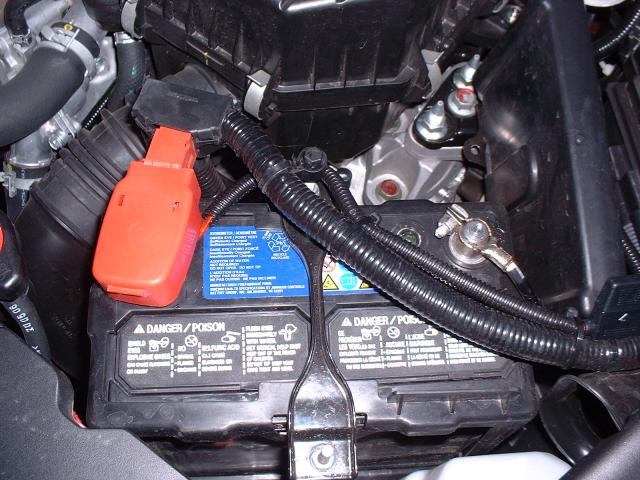
This weekend was mostly unpleasant in the Honda side of the stable. We had not one, but two batteries fail in our Honda cars.

I mentioned to my wife while we were on our 3800 mile trek of a vacation, that the battery in the 2007 Honda CRV would need to be replaced. I had a morning in Montana when I started the engine that it gave that, slow rev sound when starting. We were lucky to make it home without swapping it out.

But that was not to be this past Saturday morning. I was making breakfast, and as it turned out we were out of eggs. My son, Diet Mountain Drew called and told us the Driver’s Education place doesn’t take checks, cash or money order only. So Mrs. OkieRover jumped in the CRV and drove cross-town to pay for the defensive drivers course.

On her way home she stopped at Braum’s to pick up eggs. About the time I had decided, Mrs. OkieRover wasn’t going to come home…ever. She called and told me the CRV would not start. So I ate my plate of hashbrowns, no eggs, and went to get her.

We jumped the CRV and drove home. I grabbed an 8mm deep socket and headed to O’Reily’s to get a new battery. I bought the last one, they had. (This is important for the second half of the story so try to keep up.) I installed it right there in the parking lot. This saved me having a core charge and the hassle of having it reversed on my ATM card.

So a few hours later I have a call from Diet Mountain Drew, and as you may have guessed, the Civic would not start. My eldest daughter was en-route to him, but instead he got a jump from his friend Justin.

So I now had another battery dead. I had to go to the grocery to buy sandwich fixin’s for my newly found biologically related OLDER brother (more on this later) and family to come over for a visit. When I came home I jumped the Civic and drove it to O’Reilly’s. As it turned out…they didn’t have any more batteries for that model. Someone had bought the last one. (rolls eyes, heavy sigh)

I was told there was one on the south side of Norman so I drove down there to buy it. I didn’t bring any tools. If HAD remembered, the 8mm deep socket would have been WRONG! They started using 10mm sockets on the 2008 models.

The kid at O’Reily’s opened a drawer full of sockets and said that’s what we got. What they didn’t have in the drawer was a 10mm deep well socket or a 10mm wrench. They had an 11mm wrench but no 10mm. I wound up buying a set of pliers. I swapped it out and was done.

The two batteries were OEM original equipment delivered with the cars. That puts the CRV at 5-6 years old considering the manufacturer date and the Civic’s at 4-5 years. For a battery in Oklahoma with 120 degree summers and 8 degree winters, not too bad.

I didn’t need the 100$(US) each hickey for the budget but what else are you going to do? Ever push started an automatic? Yeah, me neither.

PS. We swapped a third battery in my eldest daughter’s Ford Explorer. It died on Monday while she was in line to pick up my grand daughter from school. We had a time of it swapping it out. The negative battery connector was too stretched out. We had to cut off the bolt for it had rusted and corroded. Nothing more exciting than generating a lot of sparks with a cutting wheel over a battery. It says expressly to avoid sparks near the battery. So a nice volume of sparks is always entertaining.

Batteries? We don’t need no stinking batteries. 

Thanks for reading and Happy Rovering.

Thirty Years Ago Today I Became A United States Marine (Post #298) 8/20/2012

Thirty years ago today I graduated from the United States Marine Corps Boot Camp in San Diego, California. Thirty years is a long time. But as long as it has been, every morning I wake up and know I am a United States Marine.

As I wrote in my Marine Corps Story,

“Being a Marine defines everything I am today and everything I ever was. I earned the title the same way millions of men before me and millions will after me. The method may change in the future, as it had changed before my service. All Marines are fraternal brothers and sisters. I believe all Marines have served for the same basic primal reason. We serve others because that is what God put us on the earth to do. Some men and women gave their lives in this service. That will always be the cost we have to bare. Some of us give a little and some of us give everything. All those that have lived free from this gift of service owe these men and women an eternal debt of gratitude. That debt can never be paid in a lifetime and only through the rememberance of the fine men and women that provided that freedom, and a promise to those men and women from those enjoying freedom to “never to allow others to be subjugated and ruled by tyranny and fear” can it ever begin to be repaid. The respect, adventure, and pride that comes with the title, United States Marine, are all just extra benefits of serving the people of our great country and the protecting the principles we as a people hold dear.”  — Eric Stephens, September 2008.

My heart will always be draped in dress blue. I wasn’t the best Marine. I was not a poster Marine like my good friend Jason, who in 2008 was promoted to E-9, Master Gunnery Sergeant. I didn’t always fit in, but I love being a Marine. The looks of surprise on people’s faces upon them learning that I was a Marine still entertain me. Each and every day I wake up and know that no matter what I may encounter, I am a Marine, and I can adapt and overcome whatever life presents me.

God bless our Corps and God bless the United States of America.

Thanks for reading and Happy Rovering Semper Fidelis.

Steering Issues Solved…For the Most Part (Post #297) 8/19/2012

 If you recall, I left off with the last post with a cross-threaded power steering hose. Sorting it out would take a few phone calls and a lot of hope.

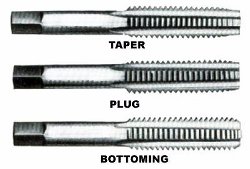
First thing I needed to do was find a tap to correct the threads I managed to mangle. There are LOTS of types of taps. And there are lots of names for those taps. It seems everyone has their own name for each type of tap. I’m sure it varies by region too. I did not know that before this project. I also did not know the name of the tap I needed. JagGuy told me I might need a bottoming tap.

Bottoming tap: 1-2 lead threads ground. Used for continuing to thread a blind hole close to the bottom of the hole. It’s difficult to start threading a hole with this tap.

Looking at the taps its easy to see the bottoming plug was best. Why? Well that is a good question. There are only 5 or 6 threads in the hole. If you use a taper tap you might not have enough threads make contact. Same issue with a plug tap. I needed the bottoming tap.

As it turns out, that was pretty easy. I just visited the amazing J&E Supply and Fasteners. I have sung their praises before. Finding the bolts and nuts for this project required me to visit them twice. Twice because I didn’t have a list of all the nuts the first time. The tap had to be a blunt or

In any event I took the “test fitting” with me and we matched it up to a tap. I was shocked they had it, but they did. I was so stoked or chuffed or happy, maybe all three at once. This tool saved me several hundred dollars American in replacing the steering box.

Having NEVER successfully tapped anything in my life…I chose to call JagGuy and ask for some sage advice. he was full of all kinds of advice for this. First bit of advice, pull the steering box. It turns out I probably would have been able to tap it in place. But, pulling it made it easier and I was able to clean it up while it was out. Second bit of advice, keep the shavings out of the unit.

To do this he suggested dipping the tap in grease. The grease captures the shavings and you just have to wipe it off to eliminate the shavings. This was easy enough.

With the advice in mind, I lined up the tap, and started it and gave it a turn. I backed it out and turned it again, like I had seen on countless TV shows. I turned it all the way to the stop and backed it out. I took the sample fitting and screwed it in. My awesome neighbor Mr. Fisher had walked over and was witness to the successful tapping. I have never been so excited. This was really awesome.

I took the new hose and threaded that as well. I was convinced now that it would not leak and I was ready to clean it up and give it a coat of paint.

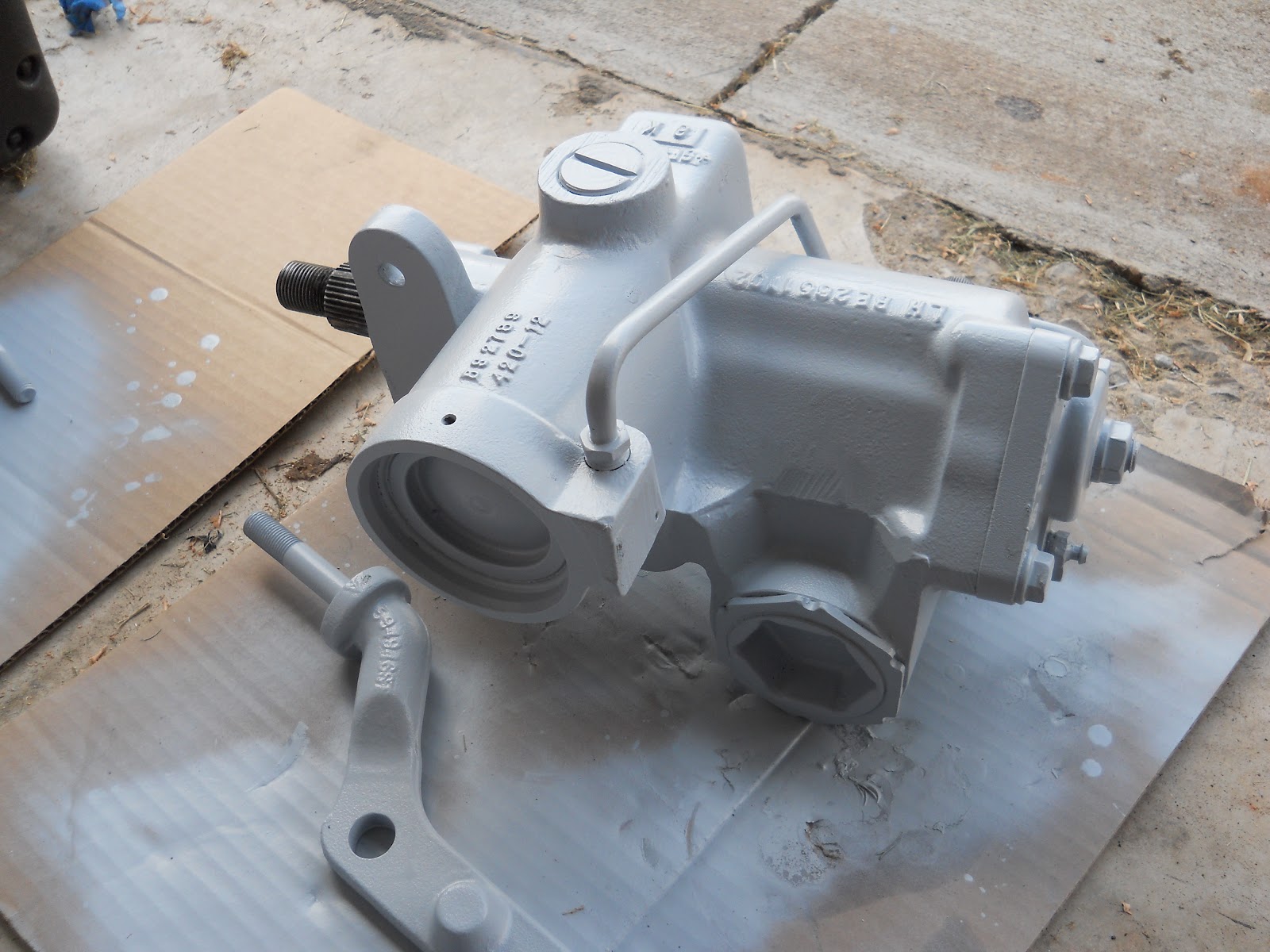
Following my habit of painting everything I pull off the Range Rover and replace I gave the steering bits a couple of coats of primer gray.

I managed to get her all together. I filled her with power steering fluid. I turned the steering wheel to the bump stops in each direction three or four times to clear out all the bubbles. I saw that on the TV as well, in fact Mr. Edd China from television show “Wheeler Dealer“ showed me that.

Okay, now that the steering box is all back together. Where am I on all this? As it turns out the steering box probably has some damage from running with low fluid. There are “spots” when I turn the wheel where I get some negative feedback from the steering. It is either this or an in accurately aligned steering shaft. The shaft has two universal joints and if you don’t have it “just right” it binds a bit. I might be having this. To sort this out I will have to get back under the hood and see if I can adjust the bind out.

On the OkieRover Difficulty Scale, this job is a three. I say three because the job is actually removing the steering box. So if you are going to swap your steering box this is a difficult job and there are lots of things to get back in place correctly.

Thanks for reading and Happy Rovering.

Steering Nightmare (Post #296) 7/8/2012

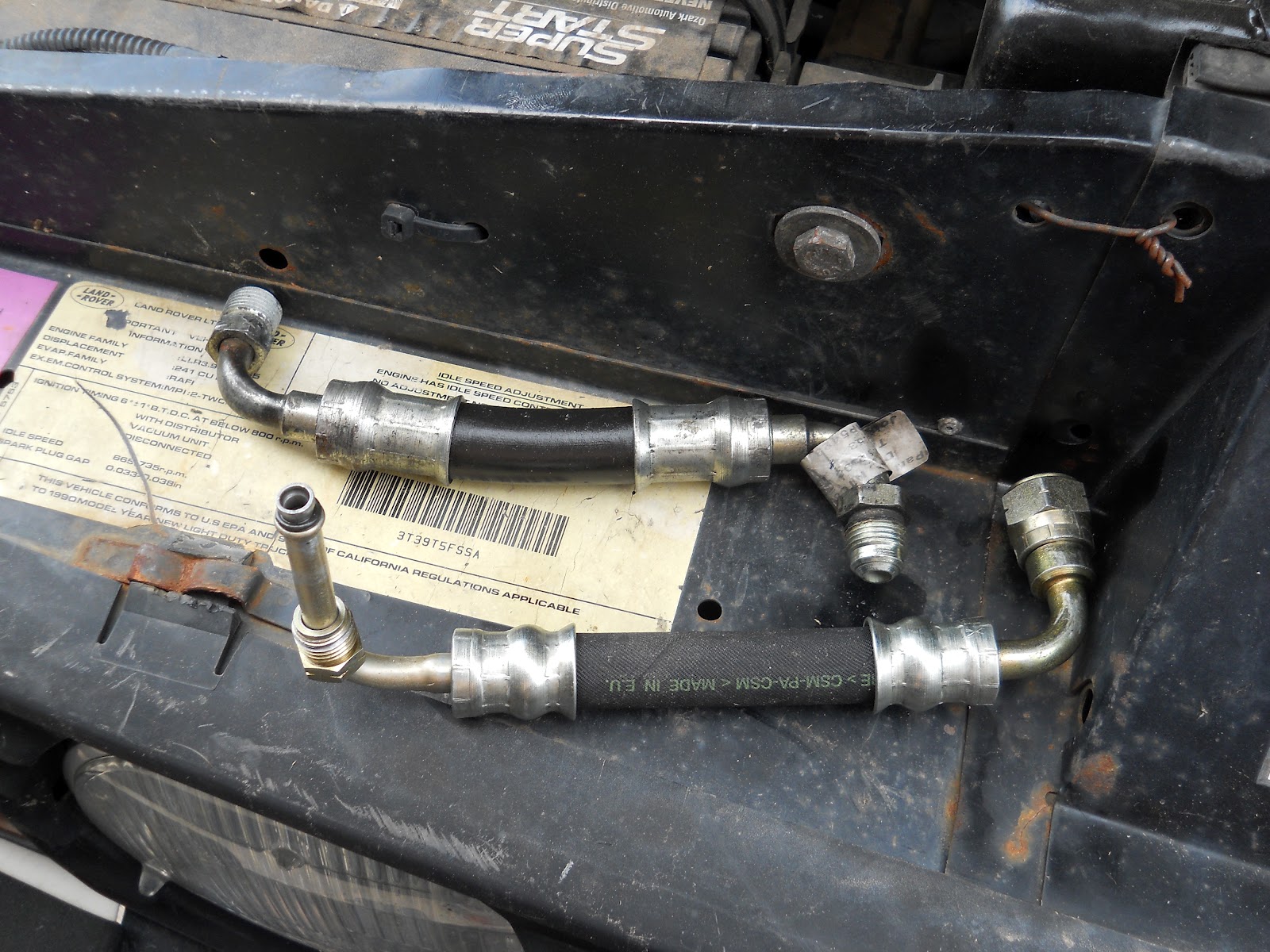
I recently purchased new power steering hoses. The pressure side of the steering assembly is plumbed by two hoses that form a “U”. The hoses allow for the flex between the steering box which is mounted to the frame and the power steering pump which is mounted to the motor.

It’s usually an easy job. I’ve replaced the hoses once before. You get a little oily but over all it is not that bad. This time was different.

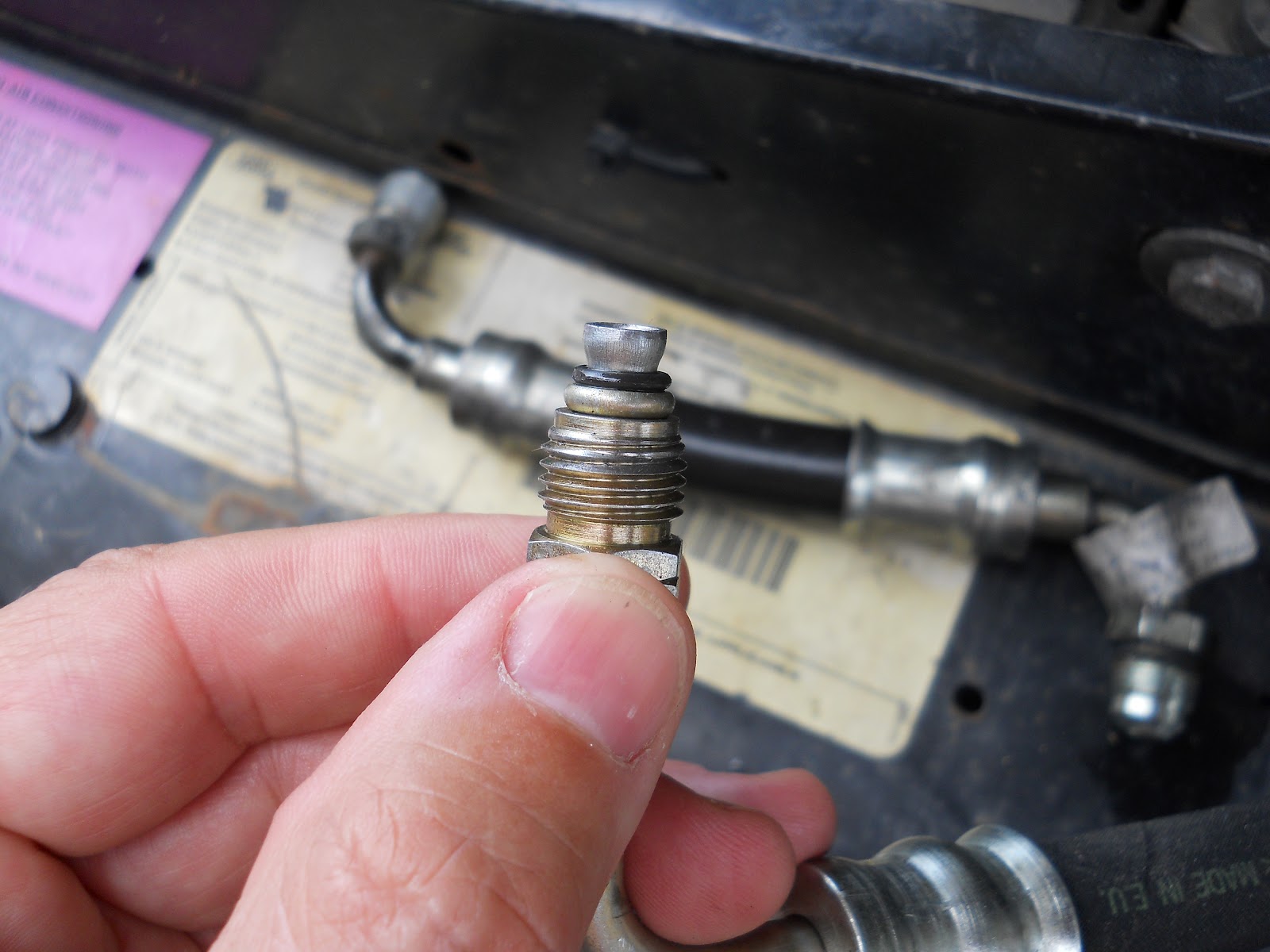
I got the old leaky hose off and was ready to put the new hose on. I lined it up and wrenched it down, or so I thought. I filled the reservoir and watched the power steering fluid pour out and thankfully into a pan I had down. I was pretty upset about this. First it was messy and second that fluid ain’t cheap. I took the hose off and began to investigate.

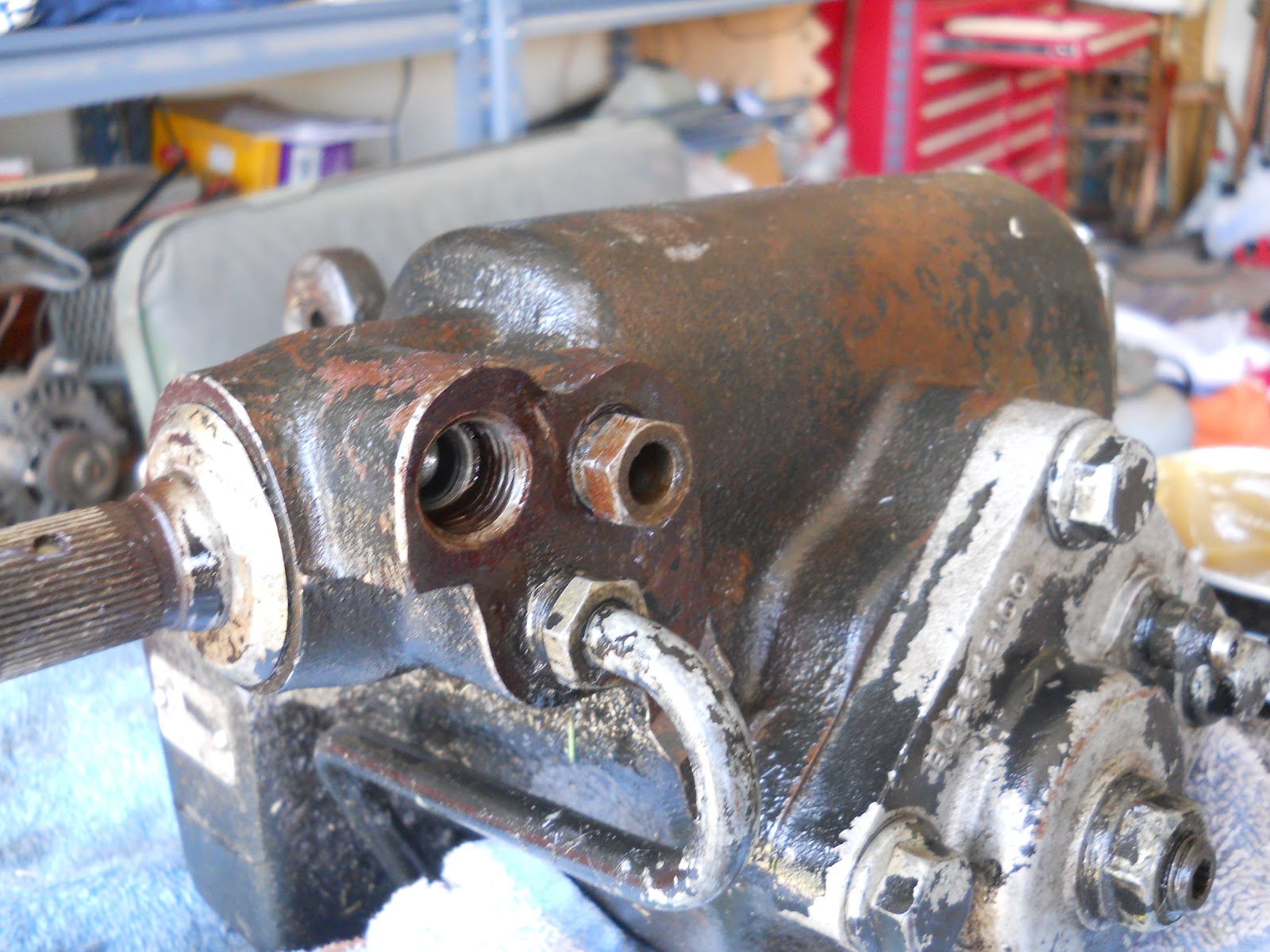
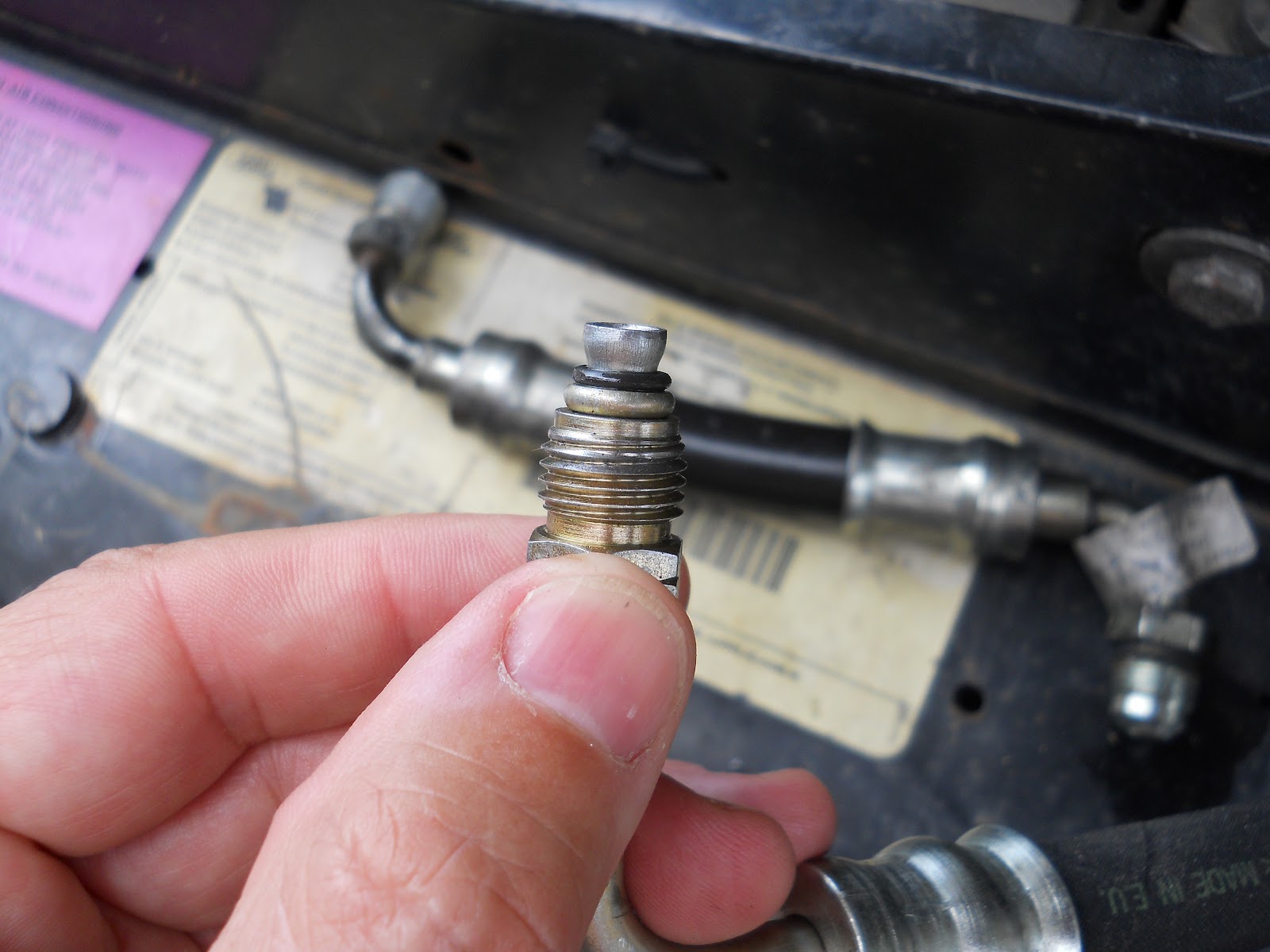
I looked at the fitting and as sure as rust will find you Land Rover, it was cross threaded. I tried to thread it again but it was a no go. I tried filing the fitting’s thread so they would turn with out cross threading but it wasn’t going to work.


I figured I would need to tap the hole and to do that the steering box would have to come out. I was not excited about that, but JagGuy confirmed it. I would have to pull the steering box.


There are a few things that need to come out before you can pull the steering box. You have to pull the shock tower and the steering shaft off.


To pull the steering box off you have four bolts that mount the shock tower to the frame. I removed the shock and then pulled the bolts for the shock tower. I should have left them in place because the steering shaft was difficult to remove with the steering box moving all around.


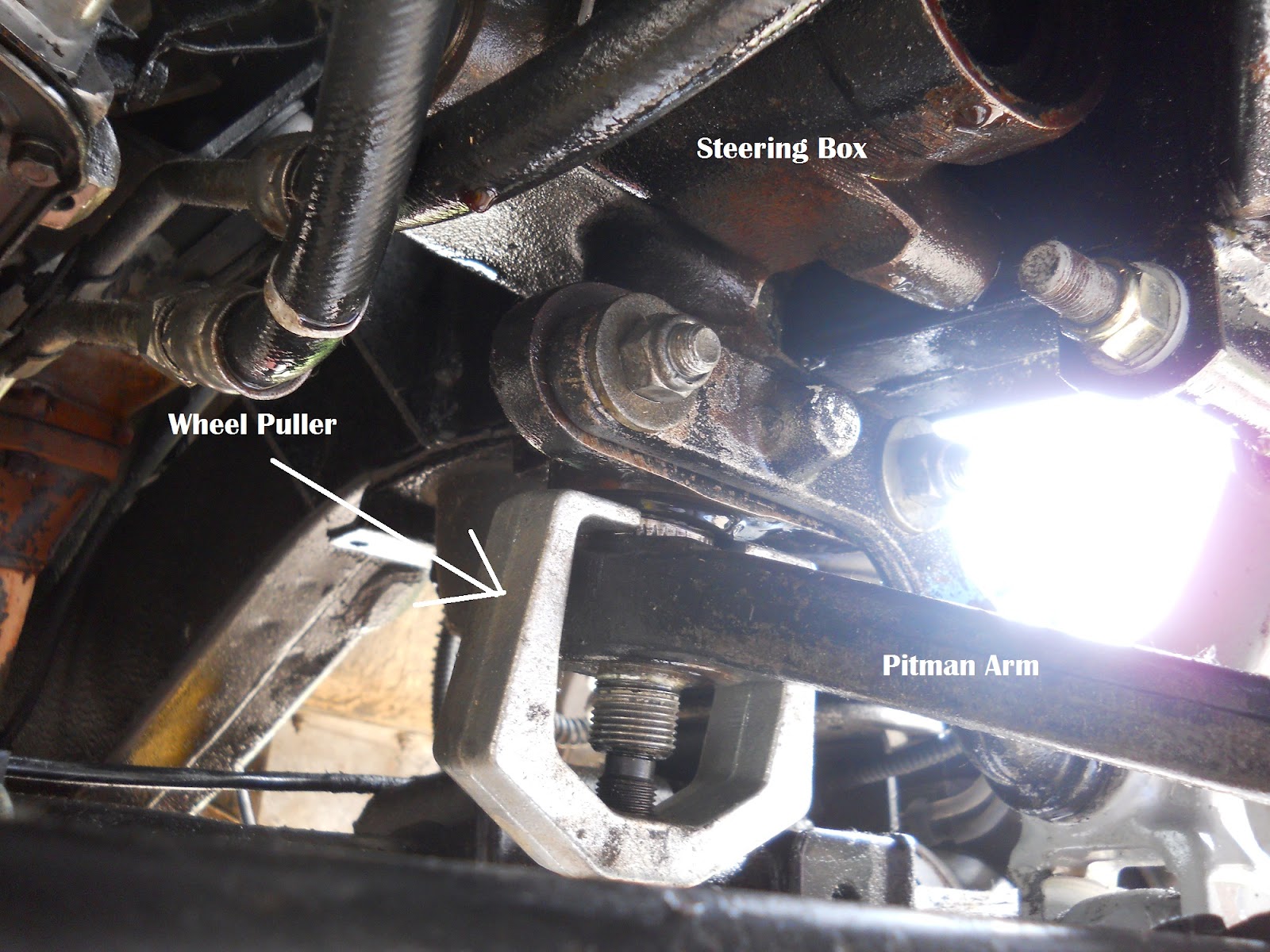
I pulled the rest of the low pressure setting hoses because they were in the way. You have to also pull the pitman arm. This takes a wheel puller.

Looking from the wheel well.

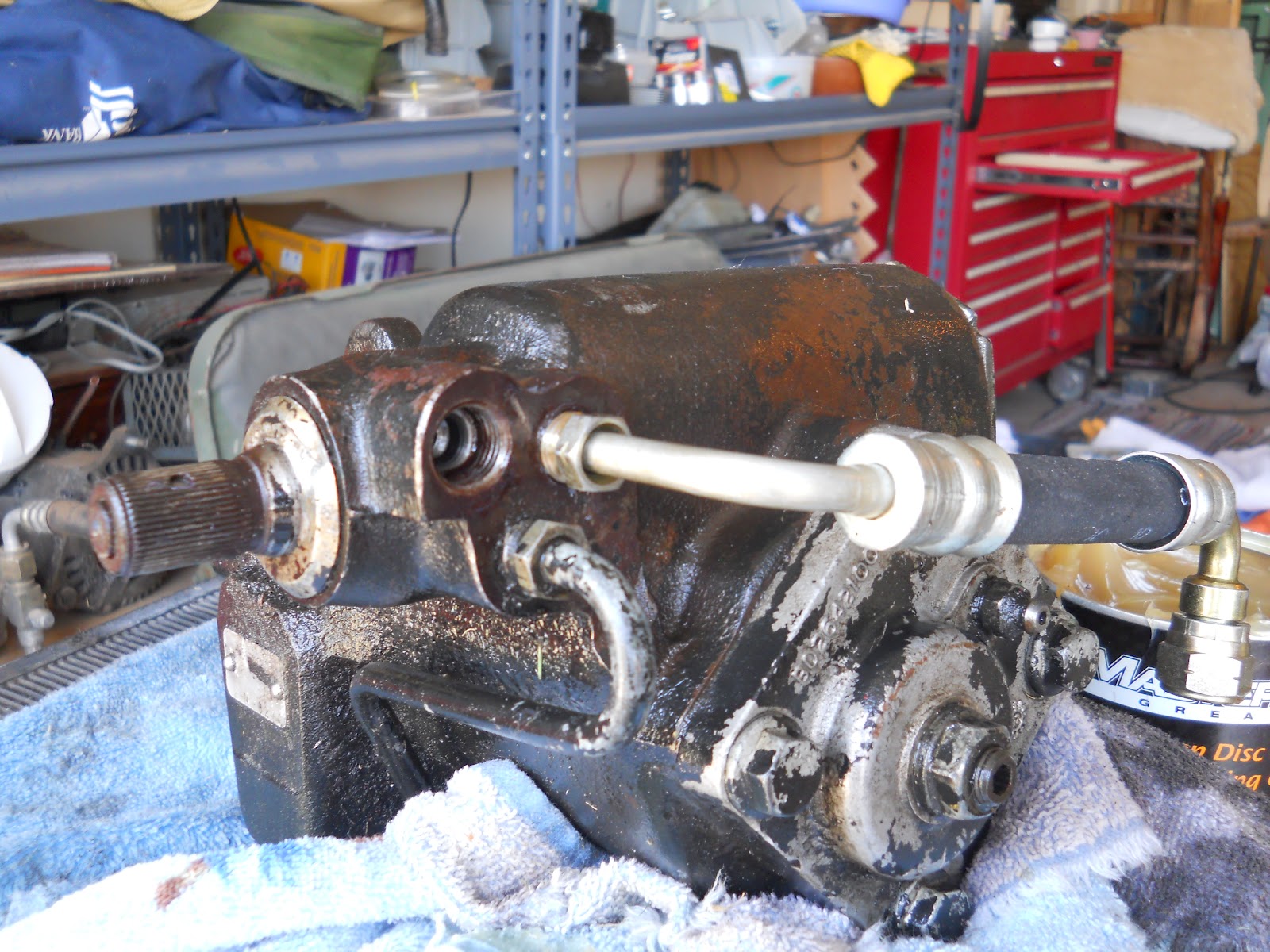
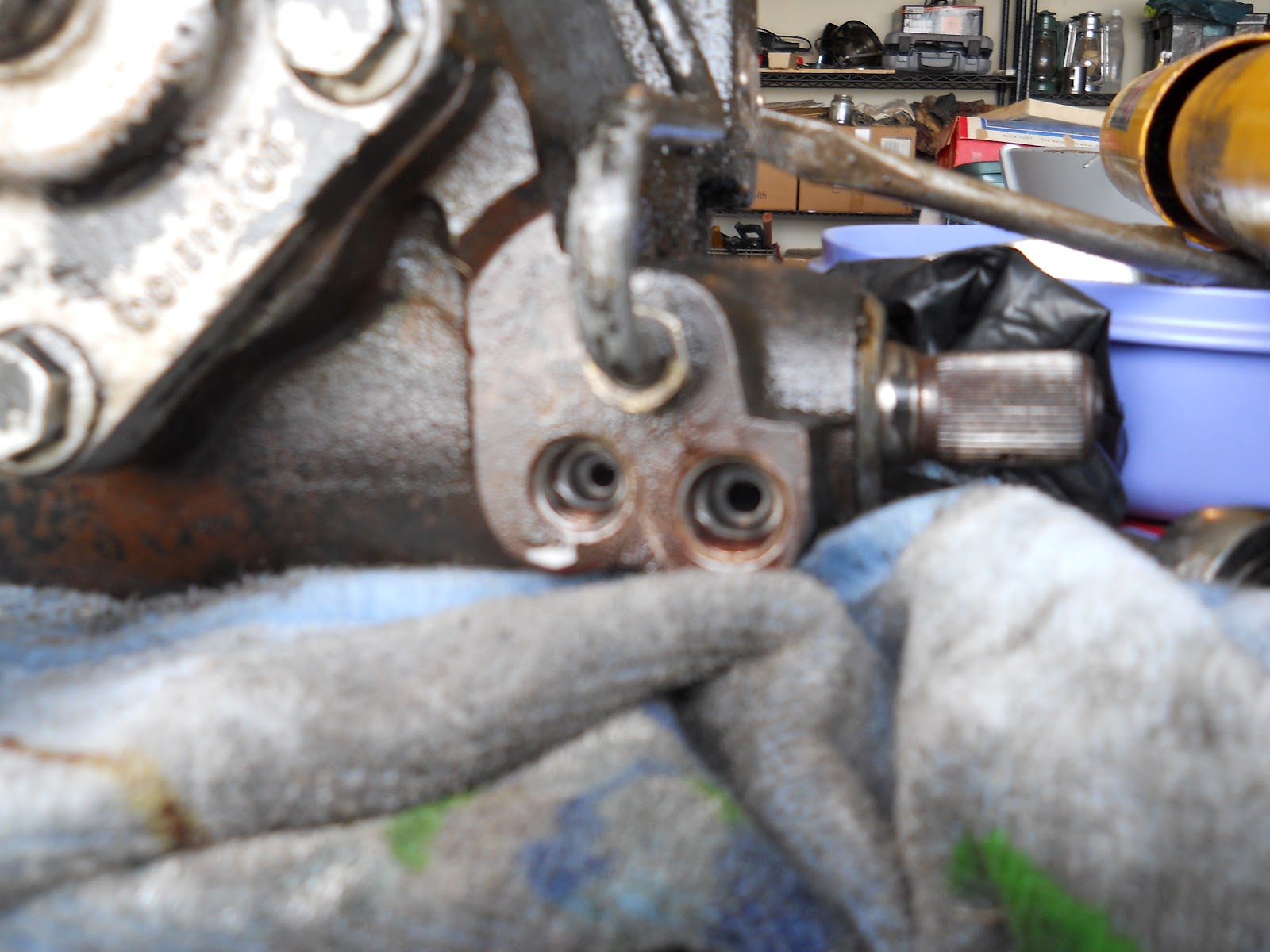
Looking from the front to the back.

This is a brutal tool and it releases a lot of energy when the pressed in wheel comes free. With everything disconnected I wrestled the steering box out.


I have it out and on the work bench. I attempted to thread the spare hose in the jacked up hole. It is really jacked up. It will have to be tapped out or (audible gasp) replaced. It costs 549.95$(US) from Atlantic British.com. Maybe after 193,000 miles I might need a new steering box. But I’m hoping this steering box will be able to be sorted out.

Like all things Land Rover…if you start working on something and things go wrong. You will experience more things that go wrong. This time I have a broken shock mount on the frame. How does this kind of thing break?

That is gonna have to be patched. I’m not sure if welding it as it is will fix it sufficiently. I’m thinking a rather large washer welded in place. Perhaps I’ll have the crack welded and a washer added and welded in place as well.

So I need to find a set of taps. Perhaps I should take the steering box to a machine shop and ask them to tap it for me. This might be the most expedient way to get it fixed.

I was surprised a how little rust there was. If you think about how much steering fluid has been leaking under there it would be nearly impossible for rust to form. There was some rust on the shocks but they seem to be working still. I’m pretty sure they could be replaced by now, they’ve been on the truck for 10 years. I need springs too but that will have to wait until I can steer again.

Thanks for reading and Happy Rovering.
UPDATE: I’ve done some Googling and found a rebuilt steering box for 265$(US) from Car Steering Wholesale.

Color matters? (Post #295) 6/16/2012

According to an iVillage post the color of your car says a lot about you. I’m not so sure about that really. I’ve read a few pages that say what the TYPE of car you drive says about you. I will acknowledge that this is at best pop-science. One of my favorite television personalities, Sheldon Cooper a character on the popular television The Big Bang Theory show often says, “the social sciences are largely hokum.”
Sorry for the video its the best one I could find.

So let us say this is all, “just for fun”.
For the record, I drive a dark silver Honda Civic. I did not “pick” it out and only bought it to help a family member, so it will not be considered in our “scientific” findings. My wife drives a gag, champagne colored Honda CRV. Similar story, helping out a family member. This will also not be considered. Neither of these vehicles actually speak to our personalities so we will throw them out when factoring the data. As you know, I have a white Range Rover. I picked it out. Therefore it is a good piece of data for our fun today.

Range Rover = Practical personality.
White =  It really depends on who you are talking to.

Suite 101 says, “According to Eiseman, white cars are associated with a fastidious nature. The UK study found that they were often preferred by status-seeking extroverts, and the New Zealand crash study found that white cars had a mid-range crash rate, similar to that of red and green.”

If you ask people about me I think they would say I could be considered some what fastidious. I had to look the word up so I’ll share the definition here,

having high and often capricious standards : difficult to please.

Nailed it.

I am an extrovert. I tested in the Myers-Briggs Personality profile as an ENTJ. So yeah, that fits too.
I do not believe I am status seeking. I am concerned about my status, but I don’t believe I go to any effort to seek any new status.
I mentioned iVillage in the opening paragraph. I will post the link to the site but it had a hellacious number of pop-ups, so be forewarned if that little demon inside you says, “Go ahead, click it.” You were warned. 
iVillage says, “White car owners are hard to please. There’s a degree of fastidiousness; says Eiseman. ‘These are people who generally like things to be very pure and pristine and clear and direct.’ There’s nothing you can hide under the color white.’ The woman who chooses a white ride is more likely to keep her car super clean. And she lives the rest of her life this way, too.”
This confirms the above from Suite101. I am very direct, perhaps even to a fault. I once thought of setting the ring tone on my phone to my wife’s voice saying, “Could you be a little less direct?” I like to be clear as well. My wife might argue that with you.

Drive Mile One says, “White is for purists who love the color for its cleansing feeling.”

Yeah, I don’t know about that. I’m pretty sure the dark recesses of my personality that will confirm this have never been explored. I will say I am a purist. Cleansing? we may never know.
Lifescript, Healthy Living for Women says, “Cloud White White has long been the conservative color of purity, innocence and doctors’ offices, which may be why many families choose white cars to transport their children in, but that doesn’t mean that white can’t spell luxury. According to ForbesAutos.com, white is the second most popular car color chosen for luxury vehicles. Being sold in sparkling hues like pearl white, this color is always on the most popular list. 
The Color Answer Book says the white is the color of the fastidious, and this may be true as a white car requires the most cleaning and upkeep to maintain that fresh, new look. Most sloppy or indifferent drivers won’t choose a color like white when it comes to car care and cleanliness.“

There we go again, fastidious. According to these three websites, I might be an uptight prick. (Eh, I can live with that.) The “Color Answer Book” apparently is on the cleaning kick too. I can say though, I like a little mud on the fenders. It shows others, “I’ve been somewhere you haven’t or can’t go.”

Maybe someday, if you buy me a beer, I’ll tell you a story about the color pink As this is a family website, we’ll leave any further discussion to beer and fire light.


My wife LOVES red cars. I don’t have the time to tell you why none of their analyses are correct about people and red cars. It’s all a lot of hokum.

Thanks for reading, thanks for participating in the social sciences, and Happy Rovering and Happy Father’s Day to all the fathers out there.

Fat Mat Installation (Post #295) 6/8/2012

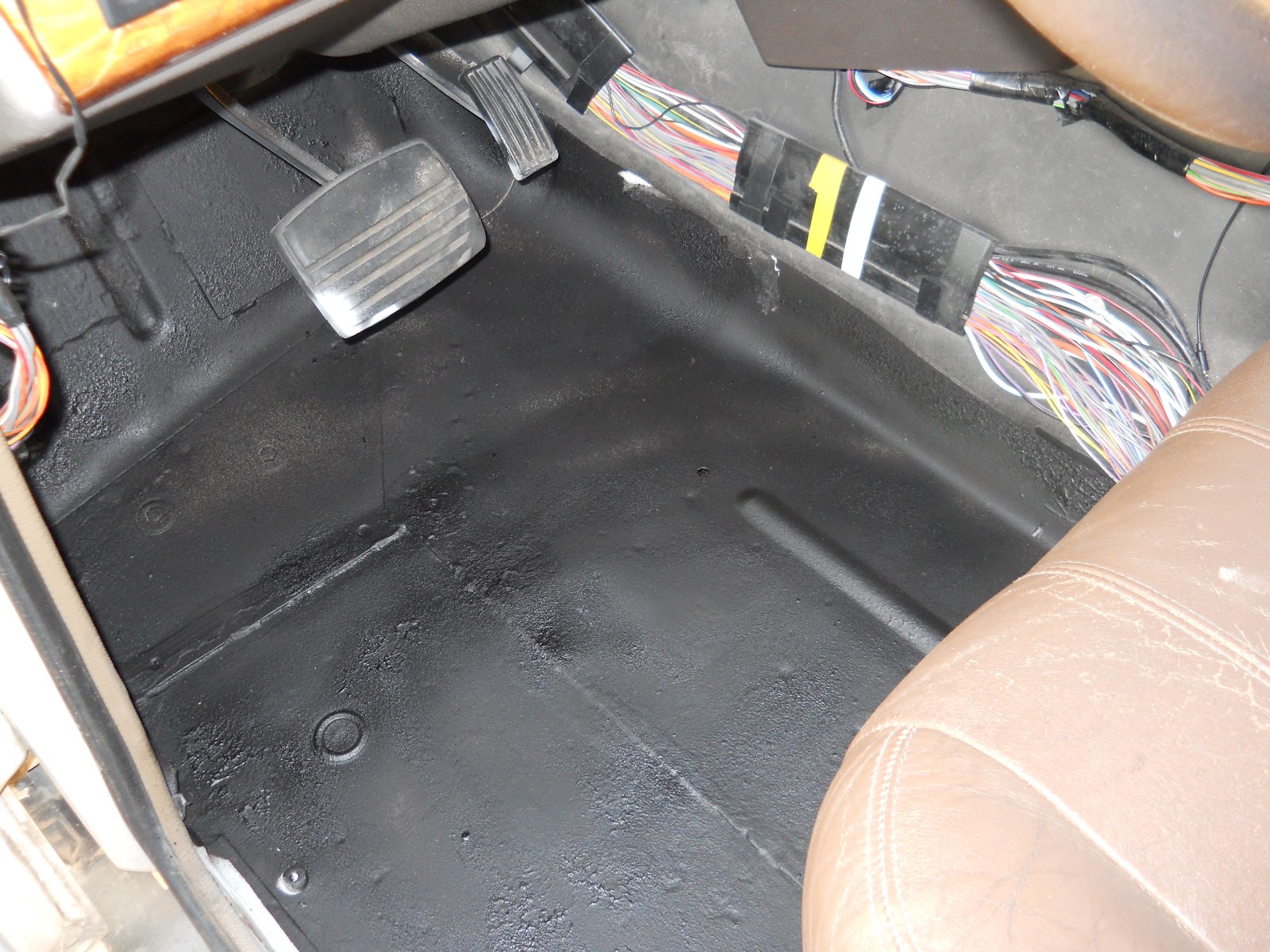
If you’ve been reading along like good little minions dis-interested onlookers followers you know about the rust issues in the front floor pan of the Range Rover. You also may have read that I was looking for sound deadening products in my post back in September 2010, Shhhh!  Last month I decided to do something about it….again. I purchased some Fat Mat sound deadener. I had two thoughts when installing it. It would…

  • Reduce heat and sound
  • Cover the floor pan
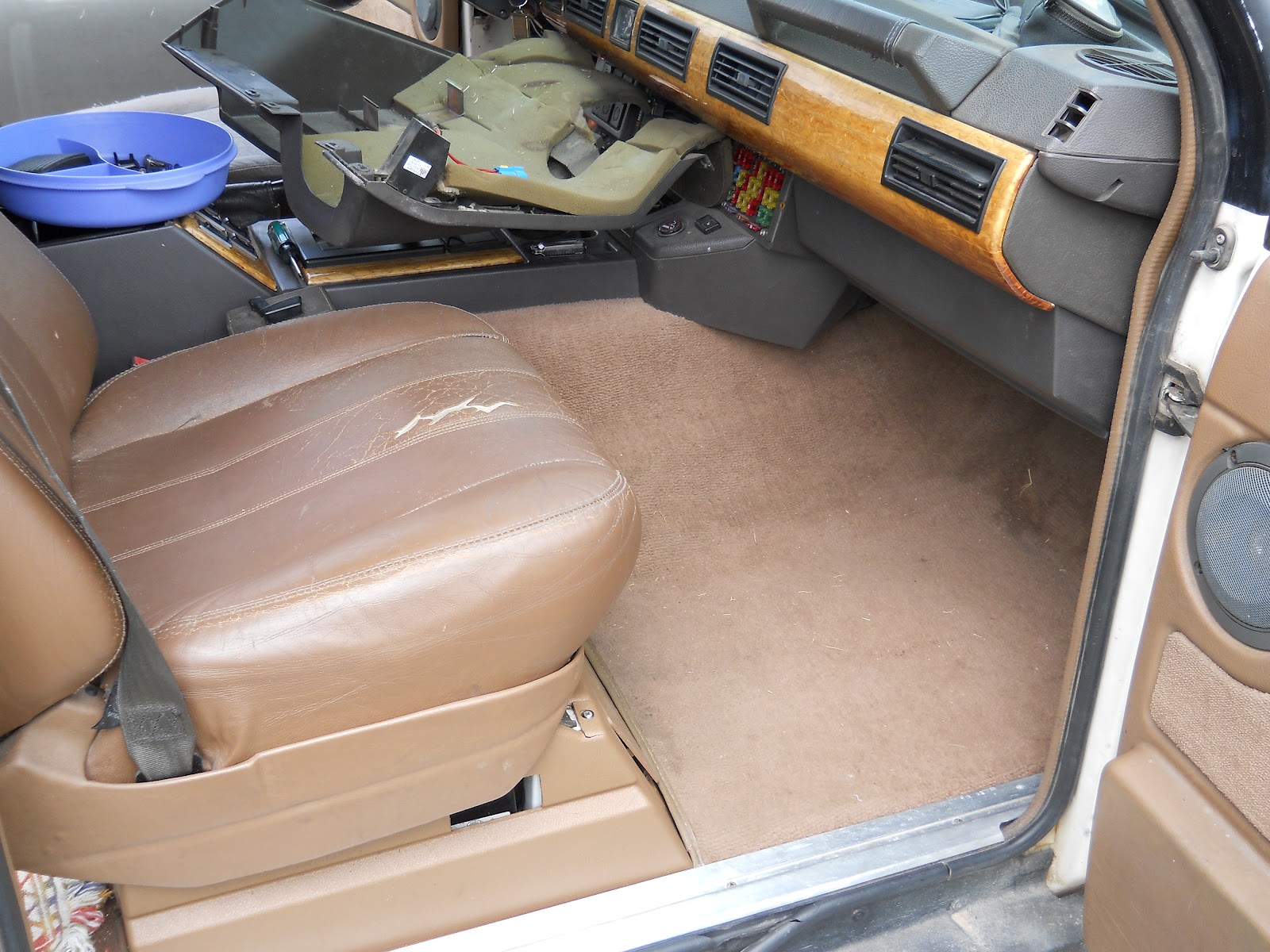
The reduction of heat and sound is a simple one. The Range Rover shipped new from the factory has a pad and carpet installed. If you pull that up you will find two small pads to reduce vibration and thus sound. The first thing you learn about the factory pad is IT IS A SPONGE. The second is it smells. And lastly it holds water and increases the rust chances for those metal surfaces.
The second to cover the floor pan, is simple, reduce water coming in contact with at least one side of the metal. I thought if I could coat the floor one more time and then cover it with this material I might minimize the rust. For certain, I won’t ever see rust there again as the Fat Mat material is very difficult to remove.
Once I began to prep the surface with grease and wax remover I noticed…the metal was already beginning to rust. Frustrated, I got the angle grinder out, too the surface down to bare metal. I then wiped the surfaces with the grease and wax remover and sprayed the surface with acid etching primer and after letting it set up. I covered the floor pan with pickup bed liner.
Over this I placed the Fat Mat.
All I can say about the install is follow the instructions. And put it on in small sheets. It would be impossible to cut the sheet correctly, peal the back, and get in place, and rolled down. As I type that I’m sure someone out there has done it or will do it. 
I was careful to cover the floor in such a way as if water DID get in there it would not seep through the Fat Mat and sit on the metal. I know the floor will rust again, I just don’t want to see it.

Over the Fat Mat I placed the OEM floor pad and then reinstalled the carpet AND all the plastic trim! Yes! The floor project is complete.
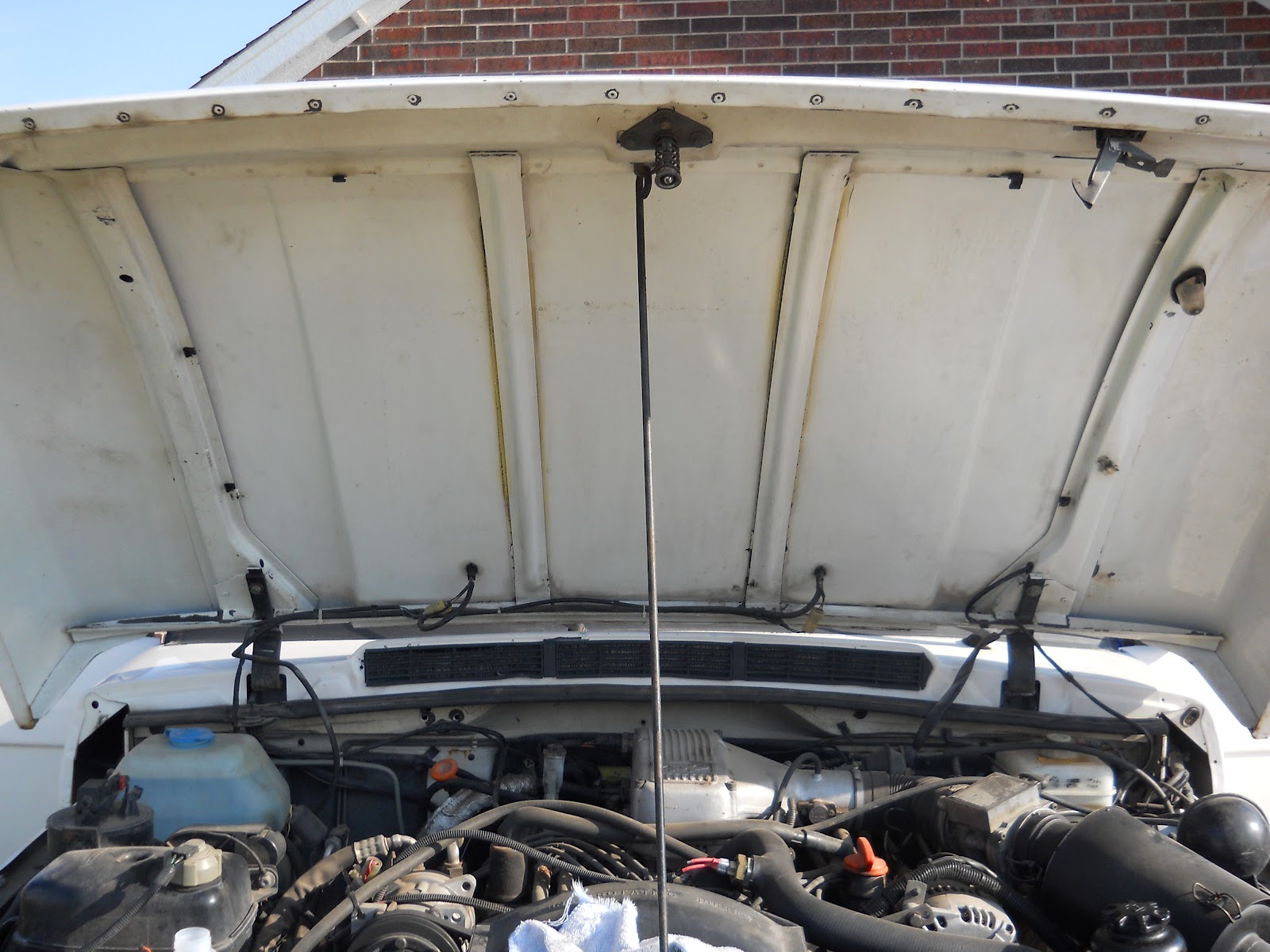
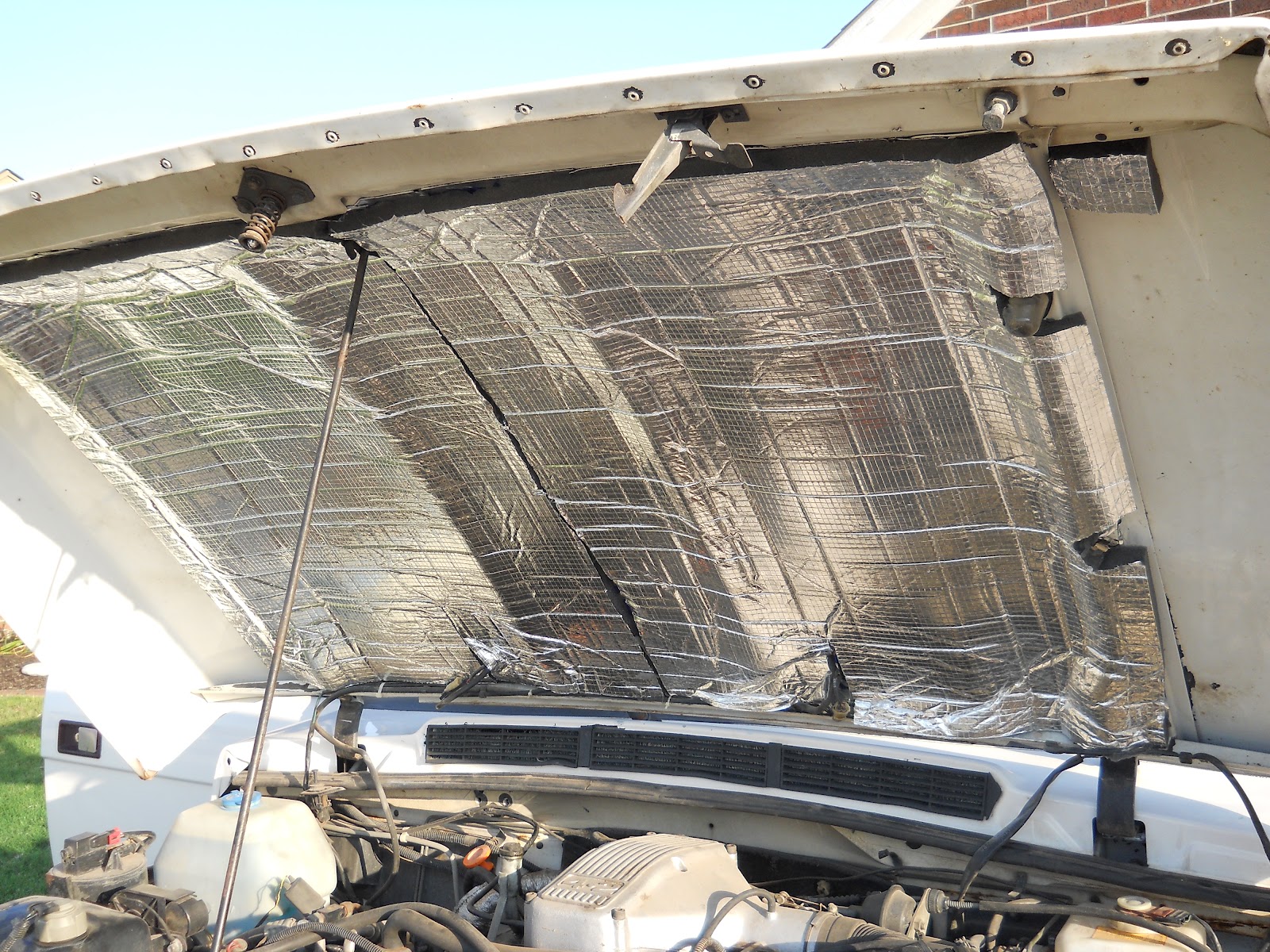
Once I had completed this I also installed a Fat Mat bonnet kit as well. This was to reduce the sound as well. I got an added bonus light is reflected from its surface down into the engine bay.

The worst part of the bonnet install was leaning over the engine bay to wipe the surfaces and to place the mat.
After everything was done I took her out for a road test. I wish I had taken readings so I could have compared them. Over all I think it is quieter. I can safely say the heat in the leg area has been significantly reduced.
Over all I’d give the Fat Mat project a 1 (one) on the OkieRover Difficulty Scale if you are just putting the stuff in sans rust abatement. I’d say this job was a 2 (two) if you have to grind any rust and spray any paint or surface covers.
Thanks for reading and Happy Rovering.