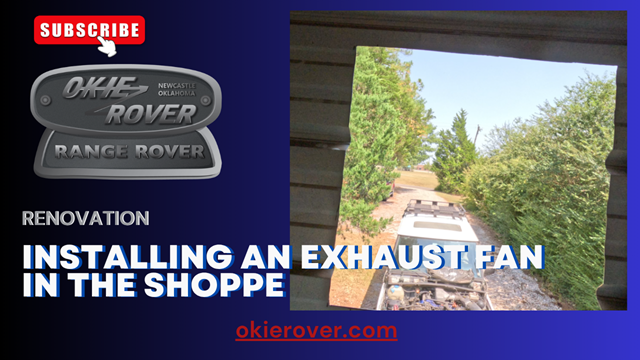
Installing an Exhaust Fan in My Shop (Post #745) 8/12/2026

OMG! If you haven’t noticed, it is hot outside. Here in the Southern Plains (never refer to Oklahoma as “the Midwest”, never). Oklahoma City has recorded about 15 to 16 days of 100-degree temperatures so far this summer in 2026, which is above the typical annual average of 12 to 13 days. We have at least 6 more 100-degree days coming. If your country has never landed a man on the moon that temperature is 37.7 Celsius.

With those kinds of temperatures my metal shop building with the lovely radiant heat effect temps often climb above 120°F (48°C). That’s warm. And for a man of my age that is considered “dangerous”. When you start looking at the wet bulb numbers you can easily quantify your chances of a heat related injury.

85-88Working or exercising in direct sunlight will stress your body after 30 minutes.Take at least 30 minutes of breaks each hour if working or exercising in direct sunlight
88-90Working or exercising in direct sunlight will stress your body after 20 minutes.Take at least 40 minutes of breaks each hour if working or exercising in direct sunlight
>90Working or exercising in direct sunlight will stress your body after 15 minutes.Take at least 45 minutes of breaks each hour if working or exercising in direct sunlight

So we have had wet bulb numbers above 85 all of August. Brutal.

So I’m looking at options to adjust the temperature of the shop down to a “reasonable” temp. That will take at least two major items to help.

Exhaust Fan

This weekend I put a 2200 CFM exhaust fan in. Shops my size should have at least a 1500 CFM fan. So I grabbed a Chinese made fan from Vevor. I ordered one with a “control module”. It was broken when it arrived. I had to repair it. Then I tested it. The temp rheostat did not seem to work as I would have expected. Set on 100°F the fan didn’t come on. So I set it to the lowest temp 32°F the fan came on about 60% speed. That is not going to be acceptable.

So I’m going to wire an old fashioned on off switch to a plug. Plug the fan in and when needed I will turn it on the day before. Simple, efficient.

The second thing in the research, planning, I need some money to buy stage is Prodex.

I’m looking at something like $1,000.00(US) to get roughly 1,410 square foot of Prodex Total 5m material and the ancillary materials to mount it to the building frames.

The testimonials and YouTube video promise I will see some significant temp reductions. And in the winter I’ll retain heat.

That’s what were up to. That’s where we are headed.

Thanks for reading, like and subscribe, and support my work by contributing on Patreon.

May the wind take your troubles away….

Unboxing with a Bad Back Parts for my Range Rover Classic Overland Rig (Post #709) 7/7/2025

I am still recovering from my back injury. I am able to unbox my bushings and shocks. Boring I know, but you do what you can when you are not quite 100% (or even 60%). Next video will be an install video for shocks for my Range Rover Classic Overland Rig.

I bought the basic shocks and a set of bushings. The rubber type. No matter what I read about poly bushings, I have experienced them failing. They are good for about 5 years. For half the price you can buy rubber bushing that last twice as long. I fell for the hype one time. Not again. If I could get OEM rubber bushings I would install them every time over poly.

The shocks I ordered were also the basic shocks. I could have popped for another set of Terrafirmas or Old Man Emu but I am on a budget. The Big White Bus had Old Man Emus on it when I first swapped the shocks. At that time I put Terrafirma on her. They served me well and I have no complaints.

So this time I went budget and if I notice them failing in the future and my need for better shocks comes up again, I’ll investigate a “name brand”. Girling is a recognized provider for British autos and motorcycles. I make a joke in the video about “girly” shocks, I’m sure these will be fine for the type of driving I do. The front set is Boge which is a German brand. I’ve never heard of them. I’m sure they will be fine too.

The next step will be removing all the suspension parts that are going to get new bushings and taking them up to my friend’s shop to press the old out and the new in. How exciting! I wonder if Mike will quote another “Love Buffet” song for us? Love Buffet’s lead singer passed away in 2024.

Thanks for reading, like and subscribe, and Happy Rovering.

https://youtu.be/gHp8XaVtDaI

Let’s go for a ride in my Range Rover Classic Overland Rig (Post #705) 6/1/2025

I took the Range Rover around the block (technically the section lines) to get all the fluids warmed up and to gauge road readiness. The fluids did get hot. The RRC is NOT ready for the road.

What I experienced was a vehicle that has some obvious issues.

First, the shocks. I think they are tired and probably done. They’ve been on this truck for at least 15 years.

Second, my medium springs on an empty truck make the ride pretty harsh. I’ve pulled all the seats out and all the interior. Besides the noise, it has very little on board to make the springs do anything.

Third, there are some bushings that have failed. You’ve seen the poly bushes in the back failing. I also experienced the signs of a panhard bush failing when the truck dives right when I let off the gas. Probably wouldn’t hurt to get them all refreshed.

I have this crazy idea to take the truck over to Mickey’s Garage and have him get her up on the lift to do an inspection. If I could get a list of all the stuff that needed replacement, I’d feel better about what I needed to do next.

In the video, I talk about my coolant being low. It took about a half gallon to top her off. Considering how long she’s sat and air bubbles getting flushed out from the engine being at full revs I’m not worried about the level changing like that.

I also had a brake light on. I had replaced the plug on the brake fluid reservoir. I got the wires swapped into the new plug and I guess one had a poor connection. I fussed with it and the light went out. I’ll probably crimp the spade connectors again to tighten them up.

I also showed off my new Knightsbridge seat covers with Molle. I’ve got a couple of bags on there and am scouring Pinterest on the potentials.

That’s about it for this week.

Thanks for reading and Happy Rovering.

https://youtu.be/WDFVjEBxj08

Reassembling the D Pillar on my Range Rover Classic Overland Rig (Post #704) 5/9/2025

In this video I reassemble the D Pillars on my Range Rover Classic overland build. If you like watching a guy assemble and disassemble stuff and get really frustrated at his dumbassery this is the right channel for you!

I managed to find the hardware in the pile of screws and nuts and bolts. That saved me a trip to the hardware store. But the side vents required new press nuts.

I had to dig through the three tiny boxes at the hardware store to get the number I needed. I needed 16. They had 18 spread across the three boxes of different sizes. So I bought all 18. I joked with the register lady that I wouldn’t charge her for organizing their entire collection of press nuts. I don’t think the joke landed.

I put this together several times. I managed to drop the washers and nuts a few times. Then I installed the right beauty panel without the vent. So it had to all come apart again. The hole covers were really brittle. I replaced them with rubber hole grommets. I cleaned it all up and it looks great. Well it looks okay. The paint on the pillars is only rattle can good. and I managed to get a couple of runs. I will have to do for now.

Thanks for reading and Happy Rovering.

https://youtu.be/EJF01ULdaCM

Fixing the Seat Switch on my Range Rover Classic Overland Rig (Post #703) 5/6/2025

In this post I show how to disassemble and refurbish a seat switch. The seat switches you find on a Range Rover Classic were also used on Discovery 1’s from 1994-1999 and BONUS tip Mercedes in the 1980s. My switch was made in WEST GERMANY. If you don’t know what WEST GERMANY is you are probably less than 40 years old. Check it out at this post [Britannica] from the old days of the Cold War.

You’ll need a few tools for this project.

  • #2 Phillips screwdriver
  • Needle nose pliers or a hemostat
  • Old t-shirt
  • razor blade or sharp pen knife
  • Q-tips
  • Toothpick
  • Dielectric grease (optional but highly recommended)
  • Steady hands
  • Patience
  • Faith

The t-shirt is so when you drop a spring or ball bearing it doesn’t go anywhere. These are small and if it travels more than 2 feet from the switch casing it will fall into a worm hole and disappear from your current plane and travel to another you are unable to reach in your corporal form. So take heed and work on this on a t-shirt or a dish towel you will certainly get yelled at by your significant other for using to work on “that damn dirty Rover”. You’re welcome.

If you have big gorilla fingers, like I do, that are riddled with hard use and arthritis, I recommend you get a hemostat or some needle nose pliers to fetch the contact rockers and springs and ball bearings. They are difficult to grab and even more difficult to drop in the precise location you want.

My final PRO TIP is to use some grease. The last time I did this job I used just ordinary bearing grease. It seemed like a good idea at the time mostly because I didn’t know about dielectric grease, or didn’t have any on hand. A little grease goes a long way to keeping the precariously balanced ball bearings atop the springs on the rocker toggles and in the toggle.

I said you might need a toothpick. I used the toothpick to remove the old nasty grease that had deteriorated into basically an earwax substance. It was still sticky and all that, but was not in its best condition, so I removed the chunks with a toothpick.

You’ll need a razor blade if you have never opened your switches. There is a substantial security tape there and it will need to be cut.

If you are a rookie, I suggest taking a picture as soon as you have the top off. And if you remove a rocker toggle, orient it on the t-shirt just like it came out of the switch.

There may be carbon build up on the contacts. You will need to get that off. I used Q-tips and the hemostat to scratch it off. I also rubbed the rockers on the t-shirt. Don’t go crazy on this cleaning. Just get the big chunks off.

Shout out to This Old Tony and his video style. https://www.youtube.com/@ThisOldTony

That’s about all the tips I can muster.

Good luck.

Thanks for readying an Happy Rovering.

https://youtu.be/qjS73xq4YQM

Diagnosing Parasitic Draw on a Range Rover Classic: Part 2 (Post #679) 11/18/2024

The Grounding.

Let the grounding begin!

When adversity strikes, that’s when you have to be the most calm. Take a step back, stay strong, stay grounded and press on. – LL Cool J

Authority is supposedly grounded in wisdom, but I could see from a very early age that authority was only a system of control. – Joe Strummer, The Clash

I’m quite grounded. – Enrique Iglesias

Like Enrique…the Big White Bus is now very well grounded. In this installment I install the grounding cables from the battery to the body and the frame. Very important things to have grounded.

The driver’s side is well grounded too. Those ground points to support the ignition system and the engine being grounded to the body. They are lovely.

The passenger side, I couldn’t say that before I finished this job. The ground points probably had not been removed and freshened up since it was wrecked by the previous owner some time in 2000.

The job was not difficult. I got side tracked with a bunch of rust and that removal made this video creep over the coveted 24 minute mark. I actually don’t know what the best length of video is. If you have a sweet spot, comment and let me know.

Three points in this job were the control module for the electric fans. The body which you connect to the fender. And finally the frame connection just behind the recovery points on the front of the frame.

All it took was a little wire wheeling with the Dremel. Cleaning he frame connector. I used a little dielectric grease between the metals. I have no fantasy that this grease will still be there even a year from now.

I found some rust and I knocked that out with some wire wheeling and applying the rust encapsulating paint. Maybe if the painting gods smile that will help keep the rust away.

That’s about it for this week. Like and subscribe and I look forward to your feedback.

Thanks for readying and Happy Rovering.